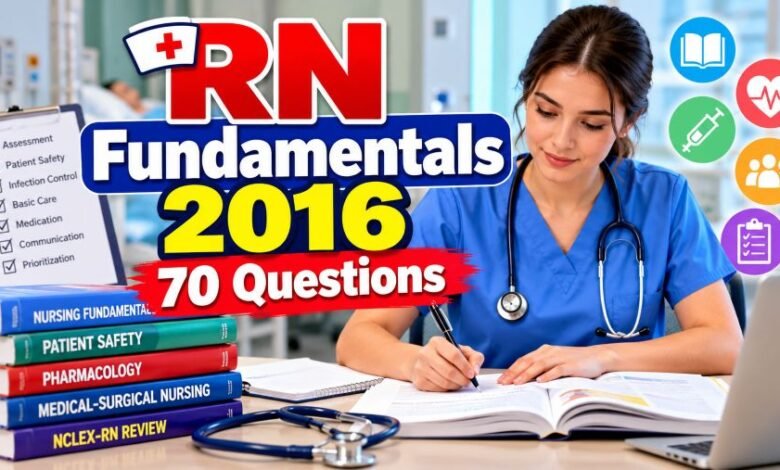
RN Fundamentals 2016 70 Questions: Topics, Study Guide and Practice Tips
What RN Fundamentals 2016 70 Questions means, what nursing concepts students should review, and how to prepare using reliable study methods.

Introduction
Students searching for RN Fundamentals 2016 70 Questions are usually trying to find information about an older nursing fundamentals assessment, study questions, rationales, or material connected with ATI nursing exams.
There is an important detail to know first.
ATI has official pages for RN Fundamentals Online Practice 2016 A and 2016 B. ATI describes the 2016 B online practice assessment as a 60-item test, rather than a 70-question practice test. It covers foundations of practice, basic nursing care, psychosocial needs, physiological needs, and health assessment.
Because of this, the phrase “RN Fundamentals 2016 70 Questions” should be treated mainly as a commonly searched study term rather than the exact verified title of ATI’s public 2016 online practice assessment.
Quick Facts
| Item | Details |
|---|---|
| Keyword | RN Fundamentals 2016 70 Questions |
| Commonly linked with | ATI nursing fundamentals |
| Main subject | Fundamentals of nursing |
| Official ATI 2016 B practice test | 60 items |
| Main focus | Basic and safe nursing care |
| Key skills | Assessment, safety, communication and clinical reasoning |
| Useful for | Nursing students and exam preparation |
| Best study method | Understand rationales rather than memorize answers |
What Is RN Fundamentals 2016 70 Questions?
RN Fundamentals 2016 70 Questions is a search phrase commonly associated with older nursing-school assessment material.
Students may see the wording attached to study documents, flashcards, review pages, quiz collections, and third-party question banks.
That does not mean every document using the title is an official ATI exam.
ATI’s official information confirms that Fundamentals is part of its Content Mastery Series, which assesses students’ understanding of concepts connected with NCLEX preparation. ATI currently lists Fundamentals as one of its RN content areas.
For students, the more useful goal is not finding an alleged exact answer sheet. It is understanding the nursing concepts behind the questions.
What Does RN Fundamentals Cover?
ATI’s official 2016 Fundamentals material identifies several major content areas.
These include:
- Foundations of practice
- Basic nursing care
- Support of psychosocial needs
- Support of physiological needs
- Health assessment
These areas cover much of what nursing students learn early in their programs.
Let’s break them down.
Foundations of Practice
Foundations of practice introduces students to the basic responsibilities and thinking processes involved in nursing.
Topics can include:
- Health-care delivery
- Professional nursing standards
- Communication
- Nursing through the lifespan
- Patient assessment
- Clinical thinking
- Patient-centered care
Questions in this area may look simple at first.
Often, however, more than one answer seems reasonable.
The student must identify which action is safest, most appropriate, or should happen first.
That requires judgment rather than simple memorization.
Basic Nursing Care
Basic care makes up a large part of nursing fundamentals.
ATI’s 2016 material includes areas such as:
- Admission
- Transfer
- Discharge
- Medication administration
- Medication error prevention
- Patient safety
- Infection control
- Comfort
- Basic patient needs
- Wound care
These are routine nursing responsibilities, but exam questions may test small details that have major safety consequences.
A student therefore needs to understand both what to do and why it is done.
Patient Safety
Safety is one of the most useful concepts to remember while answering nursing questions.
Before choosing an answer, ask:
Which option protects the patient from the most immediate harm?
Safety questions may involve:
- Falls
- Medication errors
- Incorrect patient identification
- Environmental hazards
- Mobility
- Medical equipment
- Infection risks
- Pressure injuries
Imagine that a nurse notices liquid spilled next to a patient’s bed.
Several actions might eventually be appropriate, but removing the immediate fall hazard takes priority.
That same safety-first thinking can help with many fundamentals questions.
Infection Prevention and Control
Infection-control knowledge is essential in nursing.
Important areas include:
- Hand hygiene
- Personal protective equipment
- Standard precautions
- Transmission-based precautions
- Sterile technique
- Clean technique
- Preventing cross-contamination
Students should learn the underlying principles rather than memorizing isolated answers from an old question bank.
Clinical recommendations and institutional procedures may change over time.
When older 2016 study material conflicts with current instruction, students should use current course resources and current clinical guidance.
Psychosocial Needs
Good nursing care is not limited to a patient’s physical condition.
ATI’s 2016 Fundamentals material also includes:
- Psychosocial needs
- Family needs
- Cultural considerations
- Spiritual care
- End-of-life care
Communication becomes especially important here.
A patient may say:
“I am scared about my procedure tomorrow.”
A weak response might be:
“Don’t worry. Everything will be fine.”
That sounds comforting, but it can stop the patient from discussing the actual concern.
A better nursing response could be:
“Tell me what worries you most about the procedure.”
This gives the patient an opportunity to explain the fear.
Therapeutic Communication
Therapeutic communication questions deserve careful reading.
Correct responses often:
- Encourage patients to express feelings
- Ask open-ended questions
- Clarify information
- Recognize emotions
- Keep attention on the patient
- Avoid judgment
Poor responses may:
- Give false reassurance
- Change the subject
- Give personal opinions
- Tell the patient how to feel
- Ask accusatory questions
Do not select an answer merely because it sounds friendly.
Ask what the statement actually accomplishes.
Physiological Needs
ATI’s 2016 Fundamentals material also identifies physiological areas such as:
- Oxygenation
- Circulation
- Fluid balance
- Electrolytes
- Acid-base balance
- Gastrointestinal needs
- Elimination
- Neurosensory functions
These topics start connecting basic nursing knowledge with clinical judgment.
A question may describe several patients and ask which patient should be assessed first.
That means the student has to recognize signs that may represent immediate deterioration.
Airway, Breathing and Circulation
For priority questions, students often use the familiar framework:
Airway → Breathing → Circulation
It is helpful, but it should not be treated as an automatic answer generator.
Context still matters.
For example, a patient who suddenly develops difficulty breathing generally needs more immediate attention than a stable patient requesting assistance with routine hygiene.
Look for:
- Acute changes
- Unstable conditions
- Unexpected findings
- Immediate safety threats
- Airway or breathing problems
These clues frequently help separate a priority problem from a routine nursing need.
Health Assessment
Assessment is another major Fundamentals area.
Students may need knowledge related to:
- Vital signs
- General assessment
- System-specific assessment
- Observation
- Patient interviews
- Recognizing abnormal findings
ATI specifically lists health assessment among the topics covered by its Fundamentals resources.
Many nursing questions test whether an intervention should happen immediately or whether more information is needed first.
This is where the nursing process becomes useful.
Remember the Nursing Process
One common framework is:
Assessment → Analysis → Planning → Implementation → Evaluation
When a question asks what the nurse should do first, consider whether enough information is available to act safely.
If important information is missing, further assessment may be appropriate.
But there are exceptions.
A severe immediate safety threat may require direct action.
So avoid memorizing the rule:
“Always assess first.”
Instead ask:
What does this specific patient need right now?
Medication Safety
Medication administration is also included in ATI Fundamentals material.
Review areas such as:
- Correct patient
- Correct medication
- Correct dose
- Correct route
- Correct timing
- Allergies
- Documentation
- Monitoring patient response
- Preventing errors
Suppose the prescribed medication and the supplied medication label do not match.
The safest action is not to guess.
The discrepancy needs to be clarified before administration.
That is the type of safety reasoning fundamentals questions often assess.
Prioritization Questions
Prioritization can be difficult because several answers may describe appropriate nursing actions.
Look for distinctions such as:
Acute vs. chronic
An acute change may deserve greater attention.
Stable vs. unstable
An unstable patient usually needs closer and faster assessment.
Expected vs. unexpected
An unexpected finding can indicate a new problem.
Routine need vs. immediate danger
A threat to life or safety comes before a routine request.
These distinctions are useful across many nursing subjects, not only Fundamentals.
Delegation
Some Fundamentals questions may test task delegation.
A nursing student should understand the difference between routine patient-care activities and responsibilities requiring nursing judgment.
Activities involving areas such as:
- Initial assessment
- Interpretation of findings
- Nursing judgment
- Major patient teaching
- Evaluation
generally require appropriate licensed nursing responsibility according to applicable scope-of-practice rules.
Always follow the delegation standards and scope rules taught by your nursing program and jurisdiction.
Is RN Fundamentals Still Relevant to the NCLEX?
Yes.
ATI currently includes Fundamentals in its RN Content Mastery Series and describes the series as a way to evaluate student mastery of nursing concepts connected with the NCLEX.
Fundamentals provides the base for later areas such as medical-surgical nursing, pharmacology, maternal-newborn nursing, pediatrics, mental health, and leadership.
The current 2026 NCLEX-RN Test Plan also covers clinical judgment and major Client Needs categories involved in safe nursing practice. NCSBN published the 2026 NCLEX-RN Test Plan with details on content categories, exam administration, and clinical judgment.
That means understanding the reasoning behind a Fundamentals question is more valuable than remembering an old answer letter.
Is 2016 Study Material Still Useful?
Yes, with caution.
Many core concepts remain important:
- Patient safety
- Assessment
- Communication
- Infection prevention
- Basic nursing care
- Oxygenation
- Mobility
- Medication safety
ATI’s current Fundamentals Review Module still covers foundations of practice, basic nursing care, psychosocial needs, physiological needs, and health assessment.
So the broad subject matter remains relevant.
What should not be assumed is that every clinical detail from a decade-old study document remains current.
For current exams and clinical practice, newer approved resources should take priority.
How to Study RN Fundamentals 2016 70 Questions
A strong study session should test several content areas instead of repeating one topic.
For example, students can build an original 70-question practice session like this:
| Study Area | Questions |
|---|---|
| Safety and infection control | 15 |
| Basic nursing care | 12 |
| Assessment and vital signs | 10 |
| Physiological needs | 10 |
| Communication and psychosocial care | 8 |
| Prioritization and delegation | 10 |
| Medication safety | 5 |
| Total | 70 |
This is a suggested study structure, not an official ATI exam blueprint.
Its purpose is simply to provide balanced practice.
Three-Step Study Method
Try this process.
Step 1: Take the Questions Without Notes
Answer each question as if you were sitting for an exam.
Mark any answer you guessed.
A lucky correct answer still represents an area worth reviewing.
Step 2: Study the Rationales
Do not focus only on whether your answer was right or wrong.
Ask:
- Why is the correct option right?
- Why are the other options wrong?
- What nursing principle is being tested?
- What clue in the question changes the priority?
This is where most learning occurs.
Step 3: Test the Same Concept With a New Scenario
This step matters.
If you answer the exact same question again, you may simply remember the letter.
A new question tests whether you actually understand the nursing concept.
Original Practice Questions
The following examples are newly written for learning purposes. They are not copied ATI assessment items.
Practice Question 1
A nurse sees water spilled on the floor beside a patient’s bed. Which action should be taken first?
A. Document the spill
B. Remove the immediate hazard
C. Tell the next nurse about it
D. Ask the patient to remain in bed all day
Answer: B
Removing the hazard immediately reduces the patient’s fall risk.
Practice Question 2
A patient says, “I’m frightened about tomorrow’s procedure.”
Which nursing response is most therapeutic?
A. “Don’t worry about it.”
B. “Everyone gets nervous.”
C. “Tell me what concerns you most.”
D. “The doctor knows what to do.”
Answer: C
This response encourages the patient to discuss the concern instead of dismissing it.
Practice Question 3
Which basic nursing action plays a major role in preventing transmission of microorganisms?
A. Hand hygiene
B. Keeping every patient isolated
C. Giving antibiotics routinely
D. Wearing sterile gloves throughout every shift
Answer: A
Appropriate hand hygiene is a core infection-prevention practice.
Practice Question 4
Which patient should a nurse assess first?
A. A stable patient asking for help with bathing
B. A patient waiting for discharge instructions
C. A patient with newly developed breathing difficulty
D. A patient asking when lunch will arrive
Answer: C
A new breathing problem may indicate an immediate physiological threat.
Practice Question 5
A nurse notices that a medication label does not match the prescribed medication.
What should the nurse do?
A. Administer it because pharmacy supplied it
B. Ask the patient whether it looks correct
C. Clarify the discrepancy before administration
D. Give half the medication
Answer: C
Medication discrepancies need to be resolved before medication administration.
Should Students Memorize a 70-Question Answer Key?
That is usually a poor study method.
Memorizing an answer bank can make a student recognize answers without understanding the nursing principle.
A better method is:
Question → Answer → Rationale → Nursing Principle → New Question
For example, instead of memorizing:
“Question 17 = B”
remember:
“The new breathing problem takes priority because it can represent an immediate threat.”
Now that knowledge can be applied to many different questions.
Be Careful With “Exact Exam” Websites
Searches for RN Fundamentals 2016 70 Questions can lead to pages claiming to contain exact tests or guaranteed answers.
Students should be cautious.
ATI describes its Content Mastery Series assessments as secure assessments developed to measure mastery of NCLEX-related nursing concepts. ATI says assessment questions go through processes including test-plan alignment and item analysis.
Official educational resources, current textbooks, instructor materials, and legitimate nursing review systems are safer choices for exam preparation.
Why Fundamentals Matters Beyond One Exam
Fundamentals is not simply an introductory nursing class to finish and forget.
It supports nearly every clinical subject that comes later.
Patient identification matters in medication administration.
Assessment matters in medical-surgical nursing.
Communication matters in mental-health nursing.
Infection control matters everywhere.
Prioritization becomes increasingly important as patient situations grow more complex.
That is why understanding Fundamentals pays off long after a single assessment is finished.
Final Thought
The keyword RN Fundamentals 2016 70 Questions is commonly used by students searching for old nursing fundamentals review material, but it should not automatically be interpreted as the official title or question count of an ATI online practice assessment.
ATI’s verified RN Fundamentals Online Practice 2016 B page describes a 60-item test covering foundations of practice, basic nursing care, psychosocial needs, physiological needs, and health assessment.
Use older material to strengthen concepts—not simply to memorize answers.
Focus on safety, assessment, communication, infection control, medication practices, prioritization, and the reasoning behind each decision.
That knowledge is far more useful than remembering 70 letters on an answer sheet.
Frequently Asked Questions
What is RN Fundamentals 2016 70 Questions?
It is a commonly searched phrase associated with older nursing Fundamentals test-preparation material, especially material connected with ATI-style assessments.
Is RN Fundamentals 2016 an ATI assessment?
Yes. ATI has official RN Fundamentals Online Practice 2016 A and B products.
Does RN Fundamentals 2016 officially contain 70 questions?
ATI’s official page for RN Fundamentals Online Practice 2016 B describes it as a 60-item test. Therefore, the commonly searched “70 Questions” wording should not automatically be treated as the official question count of that practice assessment.
What topics should I study for RN Fundamentals?
Focus on nursing foundations, basic patient care, safety, infection control, communication, psychosocial care, physiological needs, health assessment, and medication safety.
Is 2016 Fundamentals material still useful?
It can still be useful for reviewing core concepts. However, current clinical guidance and current exam-preparation resources should take priority when information has changed.
Should I memorize Fundamentals answers?
No. Learn the rationale and nursing principle behind each answer so you can apply it to unfamiliar scenarios.
Does Fundamentals help with NCLEX preparation?
Yes. ATI’s Content Mastery Series connects Fundamentals and other nursing content areas with mastery of concepts related to NCLEX preparation.
What is the best way to prepare?
Practice questions, review every rationale, identify weak topics, and then answer new questions testing the same nursing concepts.